

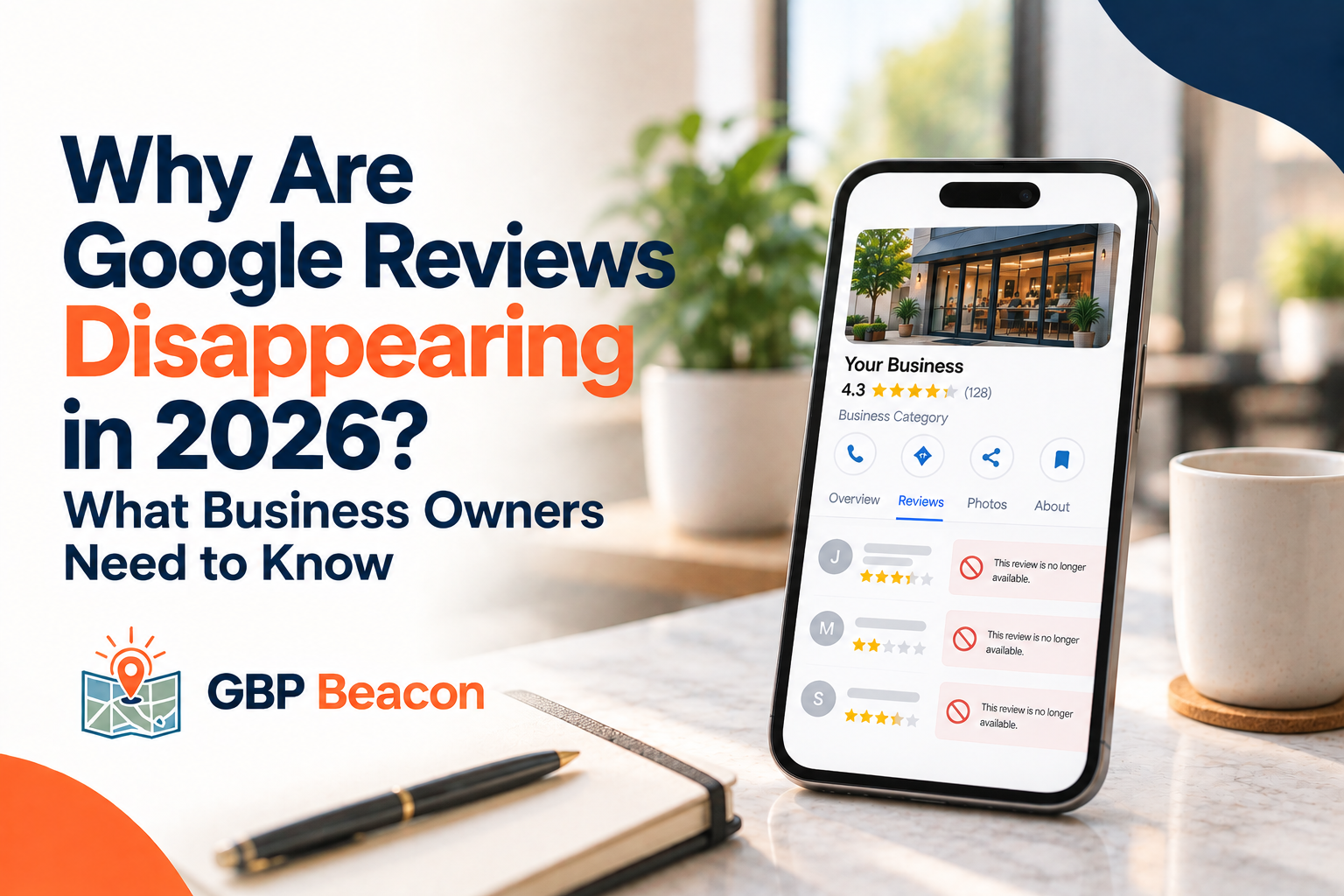
If you have noticed Google reviews disappearing from your Business Profile in 2026, you are not the only one. Since early 2026, businesses have reported reviews suddenly disappearing from Google Business Profiles. In some cases, businesses have lost only a few reviews. In others, much larger numbers have disappeared. Reports have included recently submitted reviews as well as reviews that had been visible for months or even years. For a business owner, this can be confusing and frustrating. Reviews influence how potential customers evaluate your business, and seeing your review count suddenly drop can make it feel like something is wrong with your profile. The important thing to understand is that a drop in reviews does not automatically mean your business has violated Google’s policies or that your Business Profile has been penalized. Throughout 2026, several different things have been happening at the same time: Google has strengthened its systems for identifying suspicious review activity, businesses have experienced confirmed technical issues involving missing reviews, and Google’s review policies continue to determine which reviews can remain published. Here’s what business owners should know.
Google reviews are just one part of building a strong online presence. Learn more about why your Google Business Profile matters more than ever in 2027 and how it supports your overall local visibility.
Google Review Problems Have Been Reported Throughout 2026
The review issues businesses have experienced this year have not all been the same. Reports began appearing earlier in 2026 of businesses experiencing unexplained declines in their Google review counts. One review-monitoring company reported widespread review losses between February and March, although Google did not publicly confirm that particular event or its claimed scale. By July, however, Google did confirm that it was investigating an issue involving missing reviews. Businesses and local SEO professionals were reporting reviews disappearing from Business Profiles and, in some cases, profiles temporarily being unable to receive new reviews. Google told Search Engine Land that when its systems identify suspicious reviews, it may remove reviews or temporarily pause new reviews while trying to prevent abuse. More importantly for legitimate businesses, Google also said it was investigating the situation and would restore reviews that had been incorrectly removed. That distinction matters. Not every review that disappears in 2026 should automatically be assumed to be spam, a policy violation, or something the business did wrong.
Google Is Getting More Aggressive About Review Spam
At the same time these review issues have been occurring, Google has continued strengthening the technology it uses to detect fake and manipulated reviews. In April 2026, Google announced additional protections for businesses on Google Maps. According to Google, its systems can detect sudden spikes in suspicious reviews, remove fake content, temporarily pause new reviews on a profile, notify the Business Profile owner, and display a notice explaining that contributions have been temporarily restricted. Google also reported that its systems and analysts blocked or removed more than 292 million policy-violating reviews in 2025, while publishing more than one billion helpful reviews. That gives business owners some perspective on the scale of Google’s moderation systems. Google is evaluating an enormous amount of review activity, and much of that process is automated. As those systems become more sophisticated and aggressive about identifying suspicious activity, legitimate businesses can sometimes become caught up in broader filtering or technical issues.
Why Is Google Removing Reviews?
There isn’t one single reason. Google’s official guidance says missing reviews are commonly associated with policy violations such as spam or inappropriate content. Google also says reviews are checked to make sure they comply with its policies, and that process can sometimes delay a new review for several days. Google’s policies require reviews to reflect a genuine experience with a business. Reviews can violate Google’s policies when they are not based on a real experience, are posted from multiple accounts to manipulate a rating, or are submitted because the reviewer received something in exchange for the review. However, 2026 has demonstrated why business owners shouldn’t immediately assume every missing review falls into one of those categories. Google has acknowledged situations in which reviews were incorrectly removed, meaning legitimate review loss can happen too.
Why Are Older Google Reviews Disappearing?
One of the more confusing trends businesses have noticed is the disappearance of reviews that were not recently posted. The industry data that inspired this article found reviews being removed long after publication, including reviews more than three years old. That can feel especially strange to a business owner. If Google accepted a review years ago, why would it disappear now? One possibility is that review activity can be reevaluated as Google’s systems improve and identify new patterns of suspicious activity. Google has continued developing its automated systems to detect abuse at scale. However, businesses should be careful about assuming they know exactly why an individual old review disappeared. Google generally does not provide businesses with a detailed explanation of the automated signals responsible for every review removal.
Some “Missing Reviews” May Actually Be Display Problems
There is another important issue business owners need to know about. Sometimes a review may appear to be missing in one part of Google while still existing elsewhere. In July 2026, businesses reported opening their Business Profile review dashboard and seeing messages indicating they had no reviews, even though their public listings still showed hundreds of reviews. For example, one reported profile continued to publicly show 916 reviews while the management interface showed none. Those reports pointed to a display problem rather than hundreds of reviews actually being deleted. Google has also documented a separate 2026 technical issue affecting its Business Profile API where some reviews could be missing from later pages of review data retrieved programmatically. So before assuming your reviews have actually been removed, check your Business Profile from more than one place. Look at your public listing on both Google Search and Google Maps and compare what customers can see with what appears inside your management dashboard.
Can Google Temporarily Stop a Business From Receiving Reviews?
Yes. Google officially states that when it detects suspicious review activity, it may place restrictions on a Business Profile. Those actions can include temporarily preventing people from posting new reviews or ratings, hiding reviews for a period of time, or displaying a notice that suspicious reviews were removed. Google expanded these protections in 2026. The company says that when its systems detect a sudden spike in spam reviews, it can remove the suspicious content and temporarily pause new reviews on the affected profile while alerting the business owner. This does not necessarily mean the business itself created fake reviews. Businesses can also be targeted by fake negative reviews or other forms of review abuse. Google’s newer protections are intended to respond to suspicious activity affecting the profile.
Could the Way You Ask for Reviews Be Creating Problems?
This is where businesses should take a closer look at their review strategy. Google wants reviews to represent genuine customer experiences. Asking a real customer to leave an honest review is allowed. But Google prohibits businesses from offering incentives such as payments, discounts, free products, or free services in exchange for reviews. It also prohibits attempts to manipulate ratings or encourage content that does not represent a genuine experience. For example, avoid telling customers: “Leave us five stars and we’ll give you 10% off.” You should also avoid giving multiple customers identical review text to copy and paste. Your review process should encourage customers to describe their actual experience in their own words.
What About Reviews That Mention Employees?
There has also been discussion within the local SEO community about reviews that repeatedly mention specific employees. The industry research behind this article documented examples in which groups of reviews containing the same employee names and very similar language were removed. It also observed that the overall pattern appeared more significant than the simple presence of an employee’s name. That distinction is important. A legitimate customer naturally writing: “Sarah was incredibly helpful throughout the process” is very different from a business instructing every customer: “Please leave five stars and mention Sarah.” Businesses shouldn’t panic simply because genuine customers mention employees. Instead, avoid scripting reviews or requiring customers to mention specific people, products, keywords, or positive talking points. Let customers describe their experiences naturally.
Are QR Codes Causing Google Reviews to Disappear?
There has been a lot of discussion around this question, and this is one area where businesses should be careful about misinformation. Some local SEO professionals have observed review-filtering patterns involving QR codes and direct review links and have theorized that the way a customer reaches the review form could potentially influence Google’s systems. But the mechanism described in the industry analysis is explicitly identified as a theory and has not been publicly confirmed by Google. So businesses should not assume that simply using a QR code will cause their reviews to disappear. The bigger concern is the behavior surrounding the review request. A QR code used to make it easy for a legitimate customer to leave an honest review is very different from using QR codes as part of an aggressive campaign that pressures customers, incentivizes reviews, or attempts to generate an unnatural volume of positive ratings.
Sudden Review Spikes May Receive More Scrutiny
Businesses should also understand the difference between naturally earning reviews and trying to manufacture review volume. Google’s systems look for suspicious patterns of activity. The industry research supplied for this article documented several patterns involving coordinated accounts, repeated review language, multiple accounts posting similar reviews within short periods, and accounts reviewing numerous locations of the same business in unusually short time frames. Google’s own 2026 announcement confirms that its systems specifically look for sudden spikes in spam reviews. This doesn’t mean a successful business should be afraid of receiving a lot of legitimate reviews. A restaurant might naturally receive many reviews after a busy weekend. A new store may receive increased attention after opening. A contractor could receive several reviews after completing multiple projects. The goal isn’t to artificially slow down real customers. The goal is to avoid trying to manufacture a pattern that doesn’t reflect normal customer activity.
What Should You Do If Google Reviews Have Disappeared?
If you noticed your review count dropping in 2026, don’t immediately assume your profile has been penalized. First, check the public version of your Business Profile on Google Search and Google Maps. Make sure the reviews are actually missing publicly and not simply absent from your management dashboard. Then document what happened. Record approximately how many reviews disappeared, when you noticed the change, whether new reviews are still being published, and whether you know the names of any customers whose reviews are missing. Screenshots can also be useful. Google Product Experts have recommended including information such as the Business Profile ID, number of missing reviews, reviewer names, screenshots, the time period during which the reviews disappeared, whether new reviews are still publishing, and any existing support case IDs when reporting missing reviews to Google. If the review was only submitted recently, it may also be worth waiting a few days before escalating. Google says reviews can be delayed while they are being checked for policy compliance.
Should Customers Repost Missing Reviews?
Be cautious about immediately telling a large number of customers to submit the exact same reviews again. If Google’s systems are already evaluating unusual review activity on the profile, creating another sudden wave of duplicate or near-duplicate reviews may make the situation more confusing. If a particular customer tells you their legitimate review is missing, document the review first. There are anecdotal strategies circulating in the local SEO community involving customers interacting with the Business Profile and editing their missing review. The source material for this article describes one such approach but specifically acknowledges that it is based on field observations rather than a documented Google fix. For that reason, GBP Beacon would not present it to business owners as a guaranteed solution.
What Businesses Should Do Going Forward
The safest approach in 2026 is actually pretty simple. Ask real customers for honest reviews. Don’t purchase reviews. Don’t offer incentives. Don’t require five-star ratings. Don’t provide scripts for customers to copy. Don’t coordinate review exchanges. Don’t ask employees or other people with conflicts of interest to artificially improve your rating. And don’t treat reviews as a one-time campaign where your goal is to collect as many as possible as quickly as possible. Instead, make asking for feedback a normal part of your customer experience. That creates a review profile based on genuine customer activity, which is exactly what Google’s policies are designed to protect.
The Bottom Line: Your Missing Reviews May Not Be Your Fault
If your Google reviews have disappeared in 2026, you’re not imagining it. Businesses have reported missing reviews at multiple points throughout the year, and Google confirmed at least one significant review issue in July. Google said it was investigating and would restore reviews that had been incorrectly removed. At the same time, Google has made its review-protection systems more aggressive. The company can remove suspicious reviews, temporarily restrict new reviews, and take action when its systems detect patterns associated with review manipulation or abuse. That means there isn’t one universal explanation for every disappearing review. Some reviews may have been removed because they violated policy. Some may have been caught by automated filtering. Some businesses have experienced technical or display issues. And some legitimate reviews may have been incorrectly removed. The best response is to document the loss, verify what customers can actually see, review your business’s review-generation practices, and contact Google when legitimate reviews appear to be missing.
At GBP Beacon, we help businesses troubleshoot Google Business Profile issues, understand unexpected changes to their profiles, and navigate problems involving visibility, reinstatement, optimization, and profile support. Not sure what’s happening with your Google reviews? Contact GBP Beacon and we’ll help you determine what may be happening with your Business Profile and what steps to take next.